
Monthly Market Intelligence

Beagl
Barometer™

A logistic-regression–based capacity regime detection model that identifies freight market inflection points before they show up in rates.

How the Barometer Works ↓
August 2026 Reading
30
↑ Tight Regime
Monthly Market Intelligence · Issue No. 17

Capacity Regime
Detection.
Before the Market
Admits It.

The Beagl Barometer is a logistic-regression–based capacity regime detection model designed to identify inflection points in the freight market before they show up in rates. It continuously analyzes market structure and pricing behavior, assigning a normalized reading from 0–100 with a critical trigger value of 50 separating tight and loose capacity regimes.
Current Barometer Reading
30
↑ Tight Regime
0
Very Tight
50
Trigger
100
Very Loose
Regime
Tight ↑
Trend (90d)
Tightening
Prior Month
27 ↓ 3pts looser
01

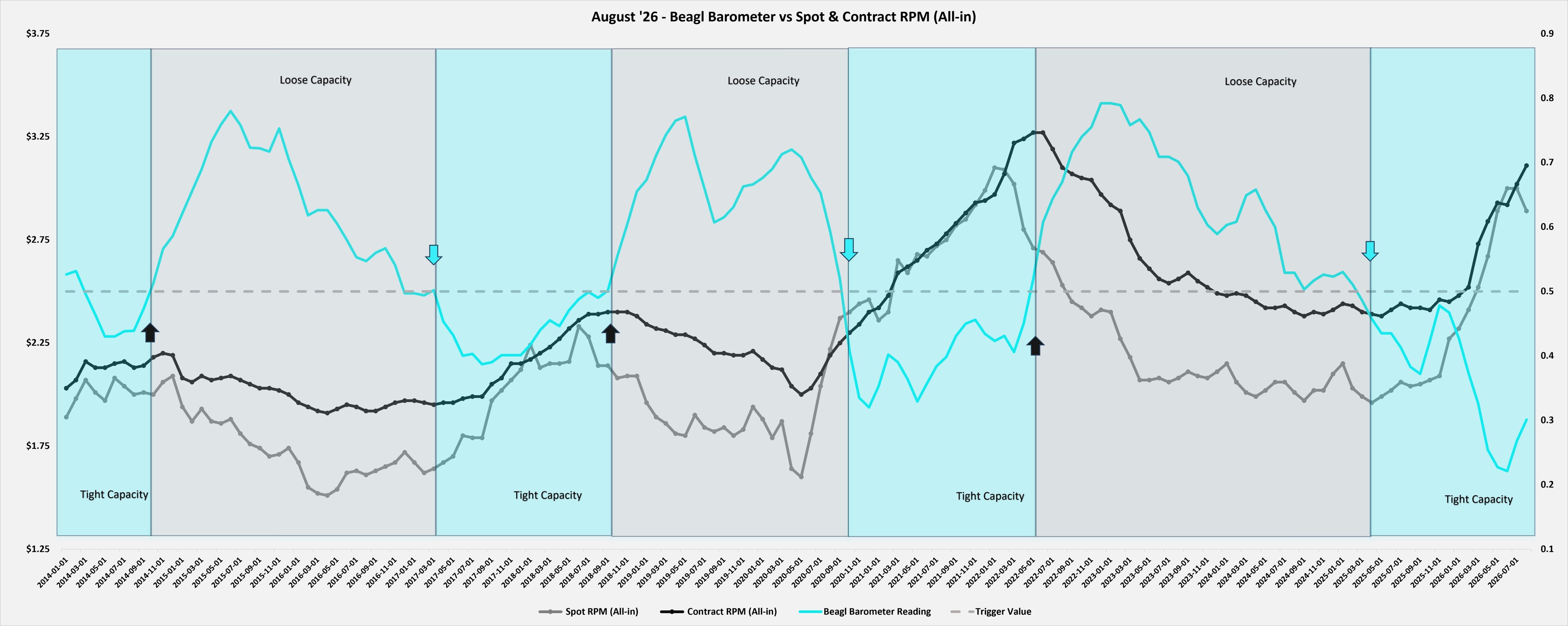
Barometer Chart, August 2026

Beagl Barometer vs Spot & Contract RPM (All-in) · 2014–2026
Beagl Barometer time series, August 2026
02

Current Regime Status

Supply
Neutral
Capacity metrics turning constructive. Active FMCSA registrations tightening while Class 8 net orders continue their recovery as fleets replace ageing equipment.
Demand
Tightening
Demand growth is slowing. Industrial production remains tight while consumption and inventory metrics have eased toward neutral.
Leading Indicators
Tightening
DAT Load-to-Truck ratio and SONAR OTRI holding tight, while broker spot rates moved back below shipper contract rates.
Sub-index
Supply index
TightNeutralLoose
46
Neutral
Sub-index
Demand index
TightNeutralLoose
34
Tight
Sub-index
Leading indicators
TightNeutralLoose
25
Tight
03

Component Data Readings

Supply Inputs
All employees, truck transportation Slightly tight
Active FMCSA Class 8 registrations Tight
Class 8 net orders Loose
Demand Inputs
Real personal consumption expenditures Neutral
Industrial production, manufacturing Tight
Merchant wholesaler sales Slightly tight
Inventory to sales ratio Slightly tight
Truck tonnage index Slightly tight
Leading Indicator Inputs
DAT load to truck ratio Tight
SONAR OTRI Tight
ATRI operating cost vs spot rates Loose
Dry van contract to spot premium Tight
04

Market Interpretation

The Beagl Barometer remains below its 50-point trigger threshold in August 2026, but has materially turned up, signaling a potential bottom in a deeply tight capacity regime. The market underperformed normal seasonal softness, with capacity metrics turning constructive and demand slowing.

Broker spot rates moved back below shipper contract rates, which continue to reset higher. We are expecting shipper contract rates to continue upward to approximately $3.19/mi by the end of the year as bid season approaches. This level of contract rates should produce more robust routing guides.

Pricing Team Action Items
Shift baseline rate horizons to 30 to 90-day forecasts, respecting seasonality for mini-bids, over 52-week historic averages.
Accelerate contract renewals on high-volume lanes before carrier leverage increases further.
Avoid over-committing to spot awards, tender rejection risk remains elevated.
Use the Barometer reading as an objective anchor in carrier rate negotiations.
Monitor contract resets closely, broker margin compression is accelerating the repricing cycle.
05

How the Barometer Works

01
Structural Balance of Available Capacity
The Barometer measures structural shifts in capacity availability. As available capacity tightens or loosens, rate shifts follow, spot first, then contract. The model detects the capacity move before it appears in pricing.
02
Logistic Regression Output
A logistic regression framework translates multi-factor supply, demand, and leading indicator signals into a normalized 0–100 probability score. The 50-point threshold is statistically derived.
03
Exploiting the Lag
Capacity tightens first. Spot rates move next. Contract rates follow 60–120 days later. The Barometer detects Step 1 before the market prices in Step 3.
•
Below 50 — Tightening capacity · rising procurement risk · upward pressure on contract rates
•
Above 50 — Loosening capacity · improving availability · downward pressure on contract rates
↑ Back to top

The Beagl Barometer™ is a proprietary capacity regime detection model. Readings are derived from publicly available freight market data and proprietary logistic regression analysis. For informational purposes and internal pricing team use only. Past regime behavior is not indicative of future market outcomes. © 2026 Beagl. All rights reserved.